Planning, design and management are the core activities used to drive an engineering project from its inception through
to a successful conclusion. These are essentially problem-solving processes.
An ill-defined problem is one that is vaguely or ambiguously formulated.
There are good reasons why engineering problems are initially poorly defined.
Even when an engineering problem has been clearly formulated and stated, it
will be open-ended, in the sense that there will not be a single "correct" solution.
Indeed, a characteristic of engineering problems is that there are alternative,
potentially acceptable solutions. The problem is not to find "the" solution but
rather to find the "best" solution.
At the commencement of an engineering project, the initial state will not be
known precisely and the target state is still undefined. In some situations it may be
very difficult to identify the required target state and, in a worst case scenario, it
will not be possible to know whether the correct engineering decisions have been
made until the project has been completed. The open-ended nature of
engineering work raises a number of important questions. In particular:
how do we solve an open-ended problem if there is not going to be a unique,
correct solution?
how can we know if we have found a good solution to an open-ended
problem?
how do we go about identifying alternative solutions to an open-ended
problem?
To find answers to such questions we need to look at problem-solving strategies.
Methodology for Solving Open-Ended Problems
In engineering work, it can be useful to draw on past practice for ideas for
solving current problems. However, it is dangerous to rely exclusively on this
approach. Adaptation is always needed, because differences inevitably exist
between past and present engineering problems, and great care must be exercised
to ensure that these differences are allowed for.
Question: Is it a good idea to keep a repository of reusable code?
Answer: Yes, absolutely!
Problem-solving strategy
When faced with a problem that is both ill-defined and open-ended, common sense
suggests that the first step should be to clarify the problem and re-state it in clear
and unambiguous terms, in so far as this is possible. If a range of alternative
approaches can be found, after the problem has been clearly formulated, then the
initial instinct may well be to choose the most "obvious" one and develop this into
a solution.
On reflection, however, it becomes clear that intuition alone will not lead
necessarily to the best, or even to a good, solution. Rather than concentrating
initially on a particular solution, it is better to take just the opposite approach and
look for as many different solutions as possible, that are feasible and promising. To
be able to do this, we need to formulate the problem in general (not over-specific)
terms so that unusual but promising solutions are not excluded.
Question: In software engineering terms, what do you call an approach where you assume an answer, then
work backwards to see if the answer is correct?
Answer: A heuristic algorithm. Also referred to as an NP problem. See
Heuristic algorithms
Our search for unusual but promising ideas will not be successful if we use
convergent thinking and rely on an analytic approach. We need to use divergent,
lateral thinking. Creativity is extremely important because we are seeking unusual,
non-routine solutions.
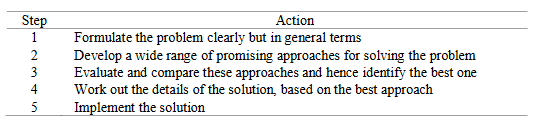
If we are successful in creating a range of different and promising solutions to
our problem, our next task is to evaluate them, compare and rank them and hence
identify the best approach. These simple thoughts lead to a problem-solving
strategy which can be applied to poorly formulated, open-ended problems. The
steps are listed below.
Question: With such an approach, would it be useful to assign numbers to each criteria and a weighting factor for each criteria?
Answer: Yes, that is often what's done. A qualitative approach is also useful.
Methodology for complex engineering problems
The strategy above will be appropriate for relatively simple, open-ended
problems where it is easy to evaluate and compare the alternative options. This
may be the case in simple activity planning tasks. If, however, the problem has
many, relatively complex, alternative solutions (and this is typically the case in
engineering work) then an enormous amount of effort would have to be expended
in the third step. A full set of designs and plans would have to be created for each
approach. This would be extremely time consuming, costly and inefficient, because
it would mean solving the detailed problem many times, once for each option.
The costs in time and
effort in the planning and design phases can be reduced enormously if, instead of
fully evaluating every option, we use an incremental approach, and start with
simple and rough comparisons of the options. On the basis of quite limited
information it will usually be possible to identify and eliminate the less
competitive options. This first step is not costly because we are using simple,
approximate, order-of-magnitude calculations. A second, rather more detailed,
evaluation of the remaining options then allows a further cull to be made.
Proceeding step-by-step in this way, we eventually identify a single best
option. If not, we will at least have a short list of the most promising options and
we can then proceed to a final round of comparisons in which we use the most
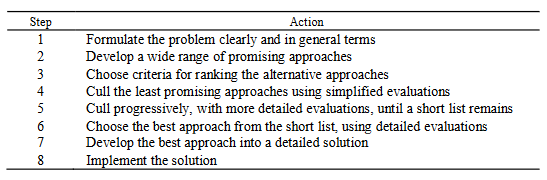
accurate analyses and calculations. With this methodology we substantially reduce the total amount of effort.
Furthermore, the more detailed calculations are made for the more promising
options. The steps in this modified methodology are listed below.
Iteration
As the design and planning work
proceeds, it will often become clear that a modification, improvement or correction
is needed in one or more of the steps already completed. In Step 4, for example,
when a new and unusual, but promising, approach is being evaluated, it might be
found that the original problem statement in Step 1 is unnecessarily restrictive.
Rather than staying rigorously with the original problem statement it is best to go
back and restate the problem in a more encompassing way, as our aim is to obtain
the best solution. Likewise, when alternatives are being compared and ranked in
Steps 5 and 6, it might become clear that an improved problem statement will
allow improvements to be made to some of the approaches.
Engineering Planning
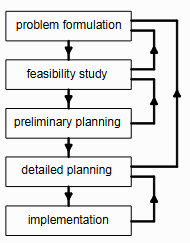
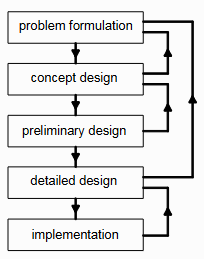
A methodology for undertaking engineering planning is shown below. It
follows closely the problem-solving methodology listed above but typical
feedback loops have been added to emphasise the need for iteration.
The overall aim of the initial problem formulation phase is to clarify and, if
possible, quantify the problem.
The feasibility study is the second phase of the process. This
term emphasises that there might not be a feasible solution. The desired outcome
from this step is of course a short list of acceptable approaches, which will
demonstrate feasibility.
Question: What greatly helps a feasibility study?
Answer: A working prototype with limited functionality.
In the third phase of the process, preliminary planning, further rounds of
comparisons and evaluations are carried out, in order to identify the best option.
The comparisons now require more detailed analysis and evaluation than
previously. If one of the alternatives stands out clearly from the others, then the
preliminary planning phase can be quickly and easily completed. On the other
hand, if the alternatives are closely matched, this phase can become protracted
because of the need for increasingly detailed comparisons.
The purpose of the detailed planning phase is to take the best option, when it
has been identified, and develop it to work out all of the details needed to
undertake the implementation. If much analysis and evaluation work has already
gone into identifying the best option, then there will be correspondingly less
detailed planning work needed. The end result of this phase is a detailed plan for
implementation. However, this might still not be the final plan. Problems can arise
during implementation that make it necessary to revisit some of the earlier steps.
Indeed, the plan will not be finalised until the project is completed.
The last phase, implementation, may require the construction or manufacture
of new components of infrastructure or the implementation of new processes. At
first sight, implementation may seem to be a separate part of the project, to be
undertaken when the planning and design work has been completed. This is not so.
Whatever form the implementation takes, it is almost always necessary to return to
and revise some of the earlier planning work.
Question: Which is more costly, to fix a mistake in the problem formulation, or a mistake in implementation?
Answer: problem formulation, because you have to make modifications to all the steps below it.
Question: What percentage of the schedule is spent on Design? Implementation? Testing and Rework?
Answer: 20% design, 40% implementation, 40% testing and rework. This ratio varies widely. Some put much more
weight on design and less on implementation. Testing and rework is always takes a large chunk of time.
Question: How true are these ratios with the assignments you have done so far?
Answer: 40-20-40, 30-30-40, 60-15-25, 30-50-20, 20-40-40, etc...
Question: When you look at the approach to design so far, which project management methodology is more suitable,
the waterfall model or the agile model? To help you, take a look at the software development life cycle:
ProductDevelopment.pdf.
Answer: For small projects, waterfall is more suitable. For large projects (and for most projects), agile (or iterative)
is more suitable, where the waterfall model can be used in sub-components of the project. The waterfall model must be
used for projects which require a high level of security or reliability, where all features have to be implemented before
the project can be deployed. See
Agile vs Waterfall, What's the difference?.
Question: Within your own company, which departments do you think you have to consult with, while working out the
design and implementation of the project?
Answer: Marketing and Engineering typically work very closely together, manufacturing, human resources (if
we need to hire), finance for financing, customer service, the test group...
The Design Process
The design process shown below parallels the process of engineering planning shown above,
although there are some differences in terminology. The emphasis here is on finding
alternative concepts, or design options, rather than on investigating feasibility.
Despite this difference in wording, the aim of the second phase is the same in both
design and planning: to produce a short list of the best feasible options for solving
the problem.
The most general, far-reaching and financially most important design
decisions are made in the initial stages of the concept design, when new, original
and unusual approaches are sought. As the design proceeds towards the detailed
phase, the design decisions become more and more specific, and they have less
impact on overall costs.
The purpose of the preliminary design phase is to study the short-listed concepts in
sufficient detail to allow the best concept to be identified. If it is difficult to choose
from several very good concepts, then successive rounds of calculations and
comparisons of increasing complexity are needed. These studies may become, in
effect, detailed designs. It is not unusual for the preliminary design phase to blend
into the detailed design phase, with detailed designs being carried out for several of
the very best options.
In the detailed design phase, the aim is to take the best approach, now
identified, and generate all the information needed to allow full implementation. If
one concept has been clearly identified at an early stage as the best, then a fair
amount of additional, detailed work will be required in this phase. On the other
hand, the effort needed in the detailed design is correspondingly reduced when the
chosen concept has already been investigated in some detail.
Something which is often forgotten or misunderstood is that the vast majority
of the work involved in design is finding out what the problem really is - and
it's rarely what you think it is. More often than not the client is asking the
wrong question. Once you've found out what the problem really is, then things
virtually design themselves because you've so comprehensively understood the
problem that the solution is self-evident.
Problem Formulation Phase in Planning and Design
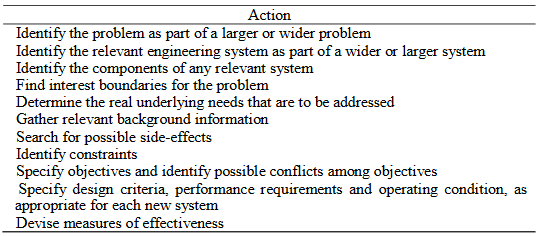
The table below contains a checklist of actions that can assist in the problem-
formulation phase of engineering planning and design. Some of the actions are information-gathering
activities while others are aimed at formulating and, to the extent possible at this
stage, quantifying the problem.
Identifying the problem as part of a wider problem
An engineering project can begin as a response to
perceived needs in the community, and the objectives may be initially poorly
defined. The problem as stated may be too vague; alternatively, the problem may
be stated in over-precise terms which imply an "obvious" solution. In the latter
case, the implied solution will rarely be the only possible one, and may not be the
best one. It is therefore important to begin the problem formulation phase by trying
to identify the problem as part of a wider or larger problem.
Question: A remote village in South America was identified as one requiring a well. The villagers had to walk for
at least half an hour to a nearby river and bring water back to the village. A social worker therefore
initiated the construction of a well for the villagers. The villagers did not use the well. Why?
Answer: They did not use the well. It turns out these villagers met members of other villages at the
river. The trip to the river was not just for water. It provided a social function.
Question: A remote village in South America was having a mild problem with famine. A social worker received funds
to aid to assist in the resolution of this problem. Instead of buying more seed and better farm equipment,
the social worker decided to let the villagers decide how to overcome this problem. They took the funds and
cleared out a field, put two goal posts at either side, and had soccer games instead. Do you think this
worked in alleviating the food problem?
Answer: Actually it did. The leaders of the village noted the low morale of the villagers and figured
weekly soccer games would go far to improving their social cohesion. As a natural result, they worked more
effectively in the fields during the week and food production improved.
Identifying each engineering system as a component of a wider system
To assist in identifying the problem as part of a wider problem, it can be useful to
identify the relevant engineering system as a component of a larger or wider
system.
Identifying interest boundaries for the problem
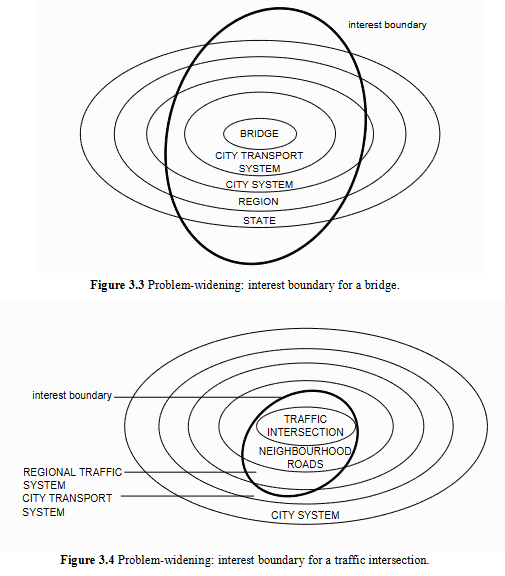
How far should the process of problem broadening be taken? At some stage the
problem broadening argument breaks down. How do we recognise this stage? The questions cease
to be relevant when they are so broad that new issues will barely influence the problem
statement. This occurs when the expanded system is so large that the original
problem (in this case, the need for a bridge, or some alternative) ceases to be
relevant. When this happens, we have clearly gone too far. The limit, where the problem has been widened to the extent that the original
problem is of marginal relevance, is referred to as the interest boundary for the
problem. The relevant solution options will be found within this boundary.
The construction of a large bridge in a small country can become an
international issue. An example was the K-B Bridge in Palau, a small island nation
in the Western Pacific, somewhat less than a thousand kilometres west of the
Philippines. The bridge was constructed in the 1970s with aid money from the
United States when Palau was its protectorate. At the time, the bridge was the
largest prestressed concrete box-girder cantilever arch construction in the world,
linking the two main islands of Korror and Babeldaob. It served a crucial purpose
for the whole population of Palau because essential services, including the airport
and power generation equipment, were located on one island while most of the
population lived on the other. The bridge collapsed suddenly and apparently
without warning in July 1996, shortly after it had undergone extensive
refurbishment. Life in Palau was severely disrupted, even though a ferry
connection was established between the islands. The construction of a new bridge
was clearly beyond the resources of Palau and had to wait until it could be
undertaken with international aid. The interest boundary in this case extended well
beyond national boundaries.
In summary, the problem-broadening process should be halted when a further
widening of the boundary has only a marginal impact on the original problem
statement. The interest boundary can be identified in this way.
Determining the real underlying needs as distinct from the stated needs
The real needs that initiate an engineering project are not always those that are
initially perceived. The process of problem widening and the identification of the
engineering system as a component in a wider system usually lead to a better
understanding of the real needs. In situations where the size and scope and influence
of a project are limited, it may be much easier to identify the relevant underlying
needs. The attempt to identify underlying needs sometimes moves attention away
from purely technical problems towards social issues and political problems,
especially when the proposed work is large in magnitude and costly. This is almost
inevitable if large sums of public money are to be spent. As the problem-widening
and system-widening processes are undertaken, the questions acquire an
increasingly political and social flavour and require community input.
Gathering relevant background information
When work commences on a new project there is usually a lack of relevant
background information. This has to be gathered as early as possible, and before
the problem formulation phase is completed. The required information may be
scientific and technological, but it may also be non-technical and sociological,
legal or political in nature. The data-gathering exercise may require consultation
with the community, the use of libraries, the internet, textbooks, and databases.
Searching for side effects
Each engineering project is designed to bring about some change in the world in
which we live. Although the intention is to improve the infrastructure and thereby
satisfy some community and individual needs, it is inevitable that there will be side
effects. These may be obvious and desirable, but also hidden and undesirable. They
may only become evident after a considerable period of time, when the project has
been completed and is in operation. In the case of a large-scale project there will
usually be a wide range of side effects, some beneficial and some detrimental.
The identification of side effects should begin as early as possible during
problem formulation but should continue into the evaluation stages because some
side effects will depend on the chosen solution. It is clearly important that the
relevant side effects be identified and allowed for when the costs and effectiveness
of each alternative approach is evaluated.
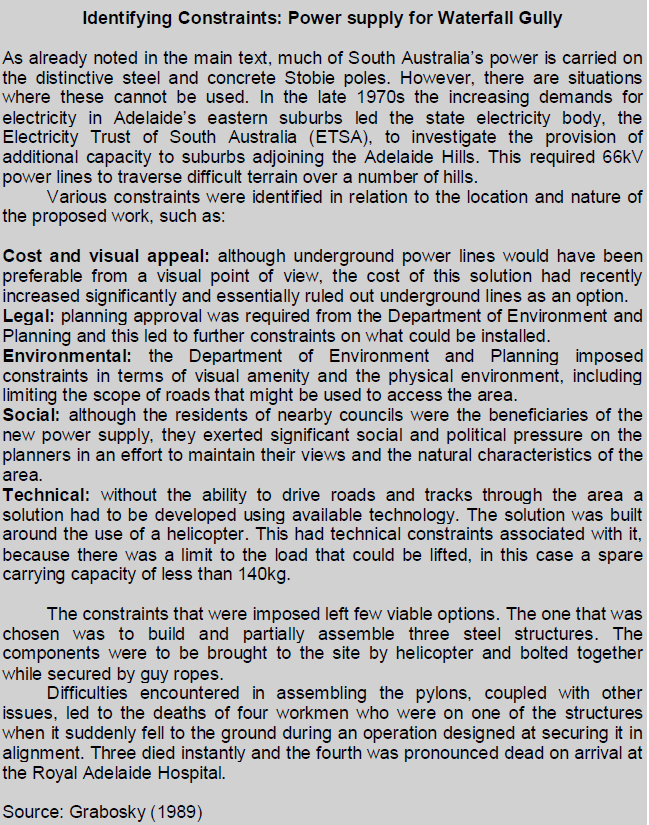
Identifying constraints
It is important in the problem formulation phase to identify the constraints that
apply to the problem. Constraints restrict the possible solutions to a problem, and
arise in various ways. They may be technical, legal, economic, social,
environmental or political in nature. Monetary cost is a constraint that applies in
one way or another to every engineering project. Constraints arise if certain side
effects are unacceptable or undesirable, such as excessive atmospheric pollution.
Technological limitations create other constraints. Legally enforceable industry
standards are often the means by which constraints arise in engineering design.
Design constraints may be introduced for the different components that make up a
system so that they fit together and work in harmony with each other.
Constraints can sometimes be quantified as physical limits or as minimum performance
requirements which must be achieved.
Defining objectives and identifying conflicts among objectives
It is important to have a clear and unambiguous statement of the goals and
objectives of any engineering project. This is, in effect, a statement of the problem,
and of what is to be achieved. While it is important to clarify the initial problem
statement, it can be advantageous not to finalise it until at least some of the
background information has been collected. In particular the process of identifying
relevant systems as components of larger systems and identifying the problem as
part of a larger problem can assist in identifying the objectives.
Furthermore, engineering projects usually do not have just one, but rather a
number of different objectives, and some objectives are very likely to conflict with
others. The twin requirements of maximum performance and minimum cost are
always going to be in conflict. It is always necessary to identify potential conflicts
among the objectives.
Specifying design criteria, performance requirements and operating conditions
The goals and objectives of a project are expanded, clarified and quantified
through the use of design criteria. Performance requirements and operating
conditions are used jointly to specify how the system that is to be created must
perform. These are used both in the detailed phases of planning and design, and in
the preliminary phases to evaluate and rank alternative approaches and concepts.
Clear and unambiguous statements of goals, objectives, design criteria and
performance requirements are particularly important should the completed project
or system not reach expectations, with resulting legal dispute.
Safety and reliability are further performance requirements which require very
careful consideration
Devising measures of effectiveness
The goals and objectives of a project are expanded, clarified and quantified
through the measures of effectiveness, which are used in the feasibility study phase
of project planning and in the preliminary and the detailed design phases. When a
project has more than one objective, one or more measures of effectiveness are
needed for each specific objective, and ideally with an overall measure that takes
account of the different objectives.
Total cost is often appropriate as the overall measure of effectiveness. This is
the case if the various objectives can be stated in terms of equivalent cost. Overall
cost is also appropriate if the various objectives can be reformulated as minimum
performance requirements, or as constraints that have to be satisfied. Not all
situations lend themselves to monetary evaluation. For example, the measures of
effectiveness might need to take account of matters such as aesthetics,
environmental effects, risk of injury and loss of life.
Question: How would you measure the success of an product from a purely engineering point of
view?
Answer: compare against the requirements and specifications. This is called compliance.
At a higher level, did it bring in profits. At an even higher level, did it solve the wider problem.
Question: How compliant should your product be?
Answer: 100% compliant with the requirements, at least 90% compliant with the specifications.
Iterating
The various activities occurring within the problem formulation
phase may need to be undertaken iteratively. The type of
background information that is required becomes progressively clearer after some
attempt has been made to identify side effects and constraints and possible
approaches. Likewise, some of the constraints and side effects are more easily
recognised after some background information has been gathered. It will also be
necessary to return to the problem formulation phase as we proceed through the
later phases of planning and design.
A Design Problem - Earthquake Early Warning System
You have to design an earthquake early warning system. You wish to
base it on the following piece of hardware which acts as a
transducer that
converts seismic activity into an electronic voltage:
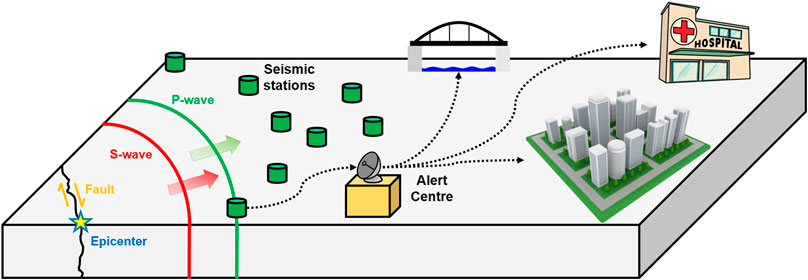
Many of these devices will be deployed over a wide area, and will communicate with a data center as
well as any relevant institutions:
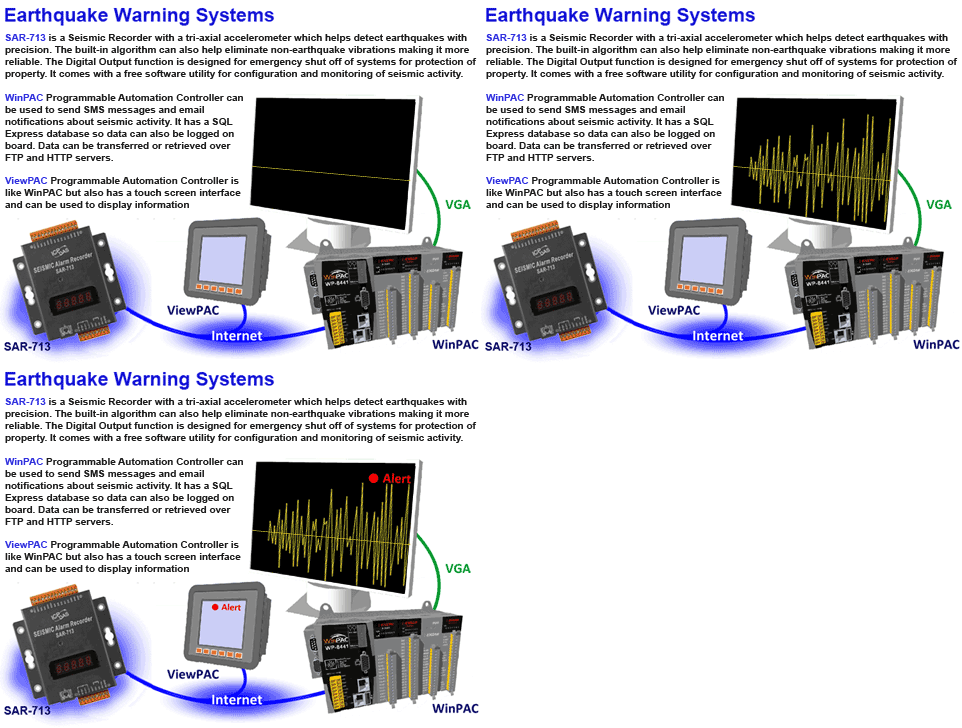
There already exists a product that somewhat performs this function. You can look at it for ideas for
your own system:
Question: You have to flesh out this problem into relevant component parts. What parts are there?
Answer: The data acquisition system, the communications network, the data center.
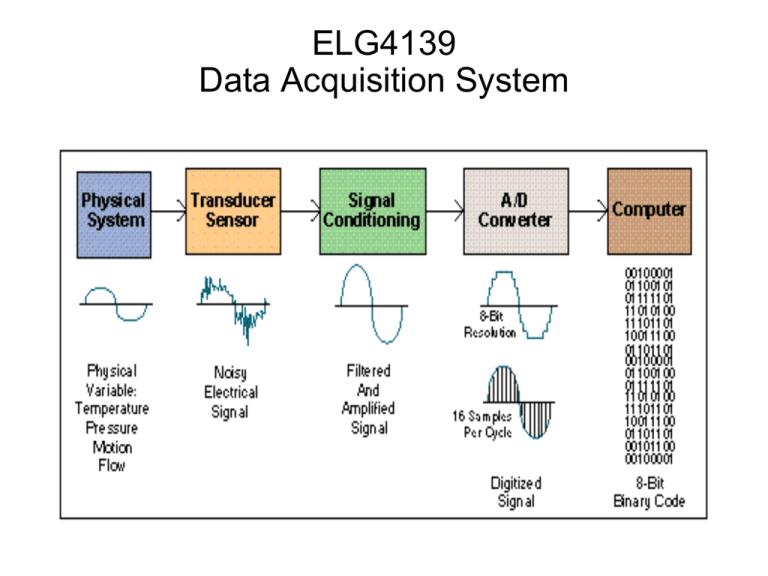
Question: For the data acquision system, data is being dumped into RAM starting from a known address.
The data rate is not that high. How will we collect and transmit this data? Is there any other information we wish to append to this data?
Answer: Shared memory. Put the data into a queue with one thread. In the other thread, filter out relevant data only,
then append any additional information such as GPS location, time stamp, error control coding,...
Question: What language are you going to write this code in?
Answer: C or C++. This is low level programming.
Question: What about the communications network? Will we piggy back off the internet? Have our own
network infrastructure? What type of communication will exist between the data acquisition systems and our data center?
Answer: We could piggy back off the internet. If the terrain is unstable, it is better to have wireless communication.
Security is not a concern, but
error control coding is. If security is a concern, say someone wants to insert false data, then we need to encrypt the
packets. TCP packets are secure and reliable, and since data rate is not high, there is no need for UDP.
Question: What language are you going to write your networking software?
Answer: C or C++ on the data acquisition side. Any
language that supports networking on the data center side.
Question: Your data center is going to require an extensive graphical user interface as well as
the implementation of algorithms for analyzing and presenting the data. What language(s) would the web based
graphical user interface be written in?
Answer: Most likely HTML and JavaScript. Could be in C#. Could be in Java.
Question: What about your algorithms? What language?
Answer: Most likely Python. Python is a great "glue-like" language
that can implement algorithms, interact with the web-interface, and extract packets off our communications network.
C# and Java are good general purpose languages that could perform all these functions, but not as well.
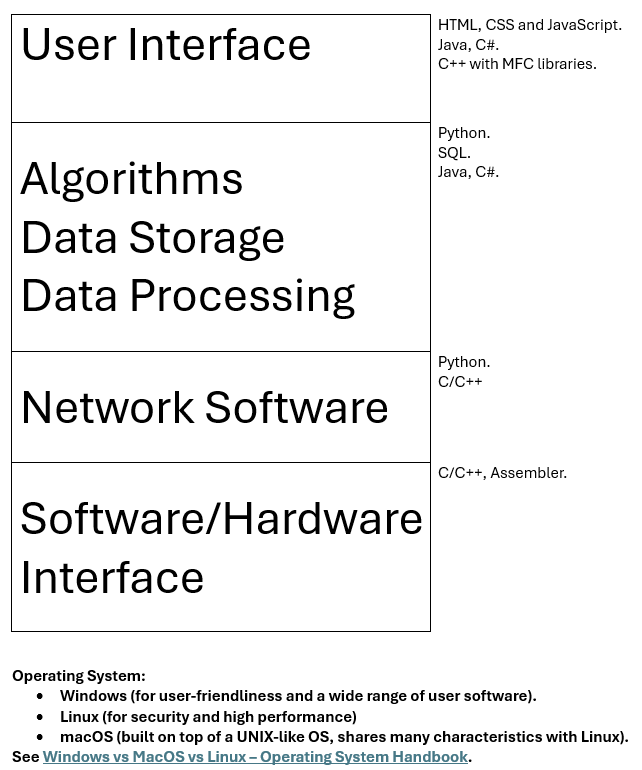
The Modules of a Generic Software Design
A software system consists of many modules. Learning and practicing modular programming is key to the building
of software systems. The document Software Product Modules
contains typical modules seen in a software product and associated languages for each module. The graphic is repeated here: